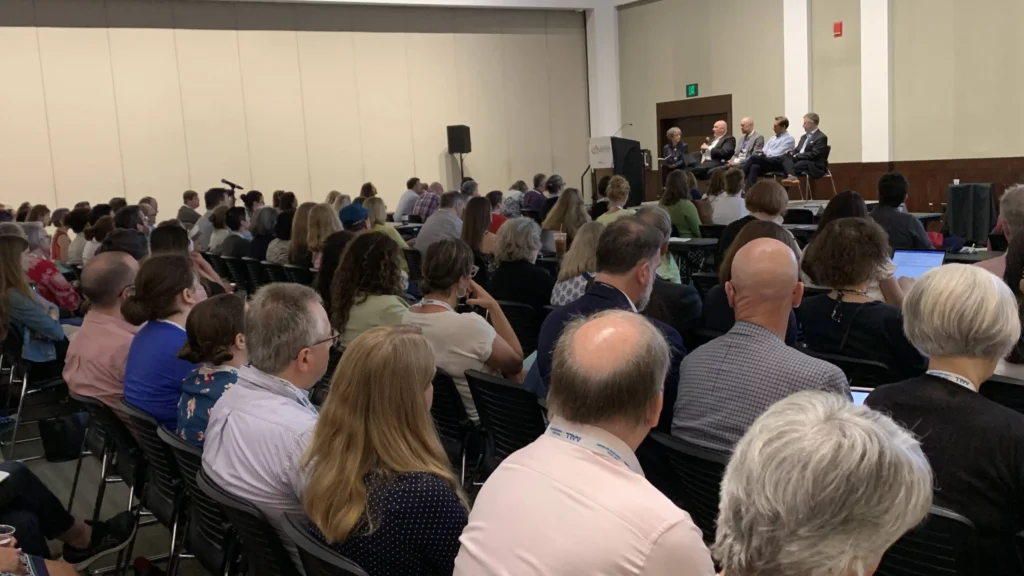
The annual conference of the American Association of Law Libraries (AALL) concluded last month in Boston, prompting reflections on the event’s atmosphere and the broader legal industry’s current state. As one attendee departed the Hynes Convention Center, connected to surrounding hotels via the Prudential Center shopping mall, an exchange with a fellow conference participant illuminated a widely held perception.
The participant stopped this writer and immediately labeled the recent gathering an “unconference,” but not in the complimentary sense of a small, agenda free event. Instead, the term conveyed a sentiment that the conference failed to cohere—it lacked a unified theme and a clear purpose. This assessment resonated immediately with this observer.
It is worth noting that this view contrasts with prior experiences. Before the previous year’s conference, this blog, Human&Legal, noted the value of the AALL conference, writing:
“Often, when I hear people rattle off the names of the leading legal technology conferences in the United States, this one is not even on their radar. That is a huge mistake. Both in its programs and its exhibit hall, the AALL conference is one of the top conferences for anyone interested in legal tech.”
This year, however, the event seemed to lack the vibrancy of its predecessors. This observation aligns with discussions held on the Legaltech Week show, where the conference was described as “a little disjointed.”
Physical Layout and Atmosphere
The chosen venue contributed, in part, to the disjointed feeling. While Boston is a welcome host city, the Hynes Convention Center and Prudential layout is arguably ill suited for a conference of this relatively small size. The Hynes is characteristically vast, necessitating considerable walking through empty spaces, even though the programs were contained within a compact area.
Furthermore, attendees were dispersed across several hotels. Although connected by the Prudential mall, moving between these locations required significant transit time. The consequence was a lack of a central gathering point—no single lobby or area where attendees could easily and spontaneously congregate. This reduced the valuable element of happenstance networking often associated with in person conferences.
The exhibit hall also suffered from an unfortunate configuration. A broad concrete section divided the space into two halves, with exhibitors split between the two sections, connected only by a long, narrow corridor. For a conference with approximately 60 exhibitors, this division diminished the cohesion of the hall and made each half appear sparsely attended.
The Overriding Factor: Generative AI and Uncertainty
While the physical environment played a role, it was likely only a minor factor. The true cause of the conference’s distinctive atmosphere appears to be a matter of unfortunate timing, specifically the sudden, pervasive impact of generative artificial intelligence (AI) on the legal profession. This onslaught has created a profound sense of uncertainty.
The profession currently finds itself in a state of limbo, positioned between a known past and an unknown future. The conference occurred precisely in the midst of this transitional period.
Legal information professionals, such as law librarians, may be particularly susceptible to this uncertainty. They are confronting a technology that few fully understand and one that some believe could threaten the future of their roles. Just a week before the conference, a survey conducted by Wolters Kluwer and Above the Law indicated that a majority of legal professionals believe generative AI puts librarians and others involved in knowledge management and research “at risk of obsolescence.”
However, others strongly disagree with this pessimistic outlook. This blog has previously championed the increasingly essential role of the law librarian in the age of AI, asserting that “Never has the role of the legal information professional been more essential.” Similarly, legal technology expert Jean O’Grady stated her belief that the profession has always been at the forefront of introducing new technologies, despite persistent predictions about its demise over the last two decades.
Nevertheless, a tangible sense of insecurity and uncertainty permeated the conference. Attendees were grappling with fundamental questions about the nature and evolution of this new technology and its implications for their careers.
The generative AI phenomenon likely necessitated late adjustments to the conference agenda to ensure coverage of the topic. While several sessions featured recognized experts, even some of these seemed to share the general sense of being “betwixt and between.” Some presentations reportedly recycled material presented in other contexts, not substantially adapting the content to the audience. This suggested that even the experts felt constrained by what new information they could offer on a rapidly developing subject.
(One notable exception was the panel “Hunting and Gathering on the Legal Information Savannah,” moderated by Susan Nevelow Mart, professor emeritus at the University of Colorado Law School. The panel featured representatives from leading legal research companies: Joseph Breda, president of Bloomberg Law; Brian Mismash, vice president of product strategy at Thomson Reuters; Vijay Raman, vice president, search and global platforms, at LexisNexis; and Edward Walters, chief strategy officer of vLex.)
Seizing the Opportunity
Despite the critique, attending the conference was valuable, and the intent is to return next year. The event suffered not from organizational failure but from its timing—it occurred during a period when the profession has significant questions for which clear answers do not yet exist.
The premise remains that the role of the legal information professional is now more essential than ever. The critical takeaway from the conference must be a call for the law library profession to move past uncertainty. The profession must seize this opportunity to proactively define and demonstrate the crucial part it will play in the development and implementation of generative AI within the legal landscape. The legal industry is heading into uncertain terrain, and few are better equipped to guide the way than law librarians.