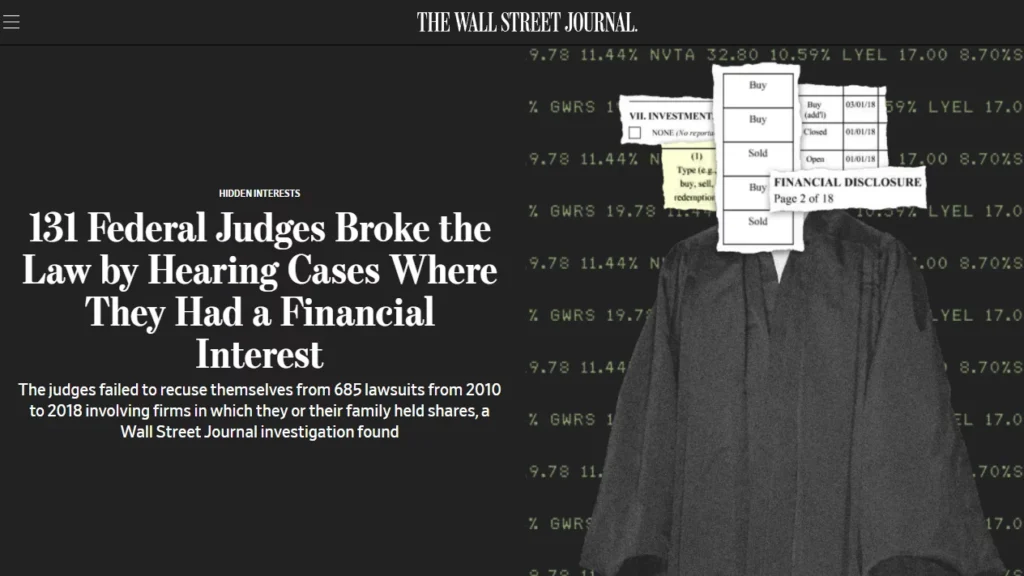
An extensive investigation by The Wall Street Journal revealed a significant ethical lapse: 131 federal judges presided over cases despite holding a financial interest, a direct violation of the law. To uncover these breaches, journalists meticulously examined the financial holdings of approximately 700 federal judges against tens of thousands of court cases.
The critical data used for this reporting was compiled by the Free Law Project, a nonprofit dedicated to providing free and open public access to court information, including data, opinions, and filings. The Free Law Project has now made this information universally available, establishing the first online database of federal judges’ financial disclosures.
The database encompasses over 250,000 pages of financial records, which the organization has gathered since 2017 through numerous requests submitted to the federal judiciary. Michael Lissner, executive director and chief technology officer of the Free Law Project, confirmed this development in a recent blog post. The files contain disclosure records for every federal judge, justice, and magistrate from 2011 to 2018, with the 2019 disclosures anticipated soon. The collection also includes some files dating back to 2003 through 2010, which were acquired from supplementary sources.
This consolidated data resource contains information on approximately 1.5 million investment transactions, 14,000 reimbursements, 12,000 sources of noninvestment income, and 1,700 gifts. Furthermore, it details agreements and debts held by the judges and their spouses.
Accessing federal judges’ financial disclosures was cumbersome until 2017, requiring individual requests, typically by fax. This procedure changed that year when the Judicial Conference authorized the release of disclosures on “electronic storage devices … at no cost to the requestor.” This authorization prompted the Free Law Project to begin systematically requesting the records.
The Free Law Project is providing access to the data through two primary channels:
- CourtListener Website: Users can search for any judge on this platform to view their disclosures. A detailed page presents all the extracted data, including investments, gifts, spousal income, and other sources of income. Users have the option to download the disclosures as PDF files.
- API Access: An application programming interface is available for those who require large segments of the data for extensive analysis. The API documentation is published on the Free Law Project website.
Mr. Lissner observed that, even with the 2017 change authorizing electronic release, the entire process—from judges reporting their financial data to the public requesting and processing it—remains cumbersome and protracted. He expressed a desire for the Judicial Conference to further modernize the process to significantly enhance transparency and accessibility, hoping that the release of this data and subsequent journalistic reporting will accelerate necessary reforms.
The Free Law Project operates on a modest budget, funded by a combination of services, donations, and sponsorships. Those interested in supporting this work can find donation information on their website. Human&Legal views this as a crucial step toward judicial transparency.