A legal technology company based in California is challenging one of the world’s largest law firms in a dispute concerning the ownership rights to specialized legislation drafting software. Each party asserts the core concept for the technology originated from its side.
The Lawsuit and Counterclaims
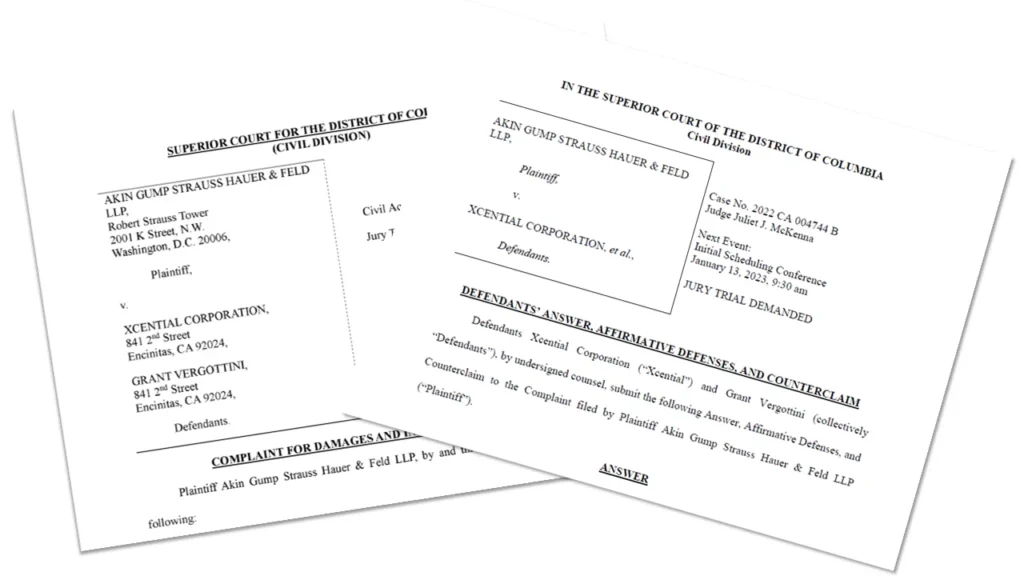
In October of this year, the law firm Akin Gump Strauss Hauer & Feld initiated legal action against Xcential Legislative Technologies. The firm’s complaint alleges misappropriation of trade secrets, breach of contract, and other causes of action. Akin Gump claims that Xcential’s Bill Synthesis software, for which Xcential filed a patent application, was actually conceived by one of the firm’s counsel, attorney Louis Agnello.
Xcential responded with an answer and counterclaim, denying that its software was derived from Agnello’s idea. Conversely, the 25 person company asserts that Agnello misappropriated its concept after receiving a software demonstration in 2019.
Attorneys at Akin Gump declined to comment on the litigation. However, Shade Vaughn, the firm’s chief marketing and business development officer, provided a statement confirming the firm’s intention to reply to the counterclaims, which it characterizes as frivolous. The firm stated it would continue to vigorously pursue its claims against Xcential for misappropriation and contractual breaches.
Executives at Xcential also refrained from speaking on the record but issued a press release. In the release, Grant Vergottini, the company’s cofounder, CEO, and CTO, asserted that Xcential was solely responsible for the design and execution of the software.
Competing Claims of Invention
The central focus of the case is Xcential’s 2019 patent application for a software prototype it named Bill Synthesis. The technology company maintains the prototype was developed from two of its existing proprietary technologies: Change Set software and an internal technology later known as Snapshot. Xcential states that both technologies arose from its experience with the federal legislative process and were shown to Akin Gump personnel in 2019.
Akin Gump, in its complaint for damages and injunctive relief filed in the District of Columbia Superior Court, and in a petition to the U.S. Patent and Trademark Office, contends that Agnello is the true inventor of Bill Synthesis. According to Akin Gump’s October 2022 lawsuit, Agnello conceived “an idea that would forever change the complex process of drafting federal legislation” and lead to a “K Street Parade” among lobbying firms.
Akin Gump alleges it approached Xcential about integrating Agnello’s concept into Xcential’s existing LegisPro software, which automates specific aspects of federal bill drafting. The firm claims that Agnello and Xcential initially referred to the prototype as the “K Street Parade” based on Agnello’s description.
In its answer and counterclaim filed November 8, Xcential denies the assertion that Bill Synthesis was based on an idea presented by Agnello. The pleading states, “Defendants deny any suggestion or implication that Agnello is the first or only person to conceive of” the software concept for Bill Synthesis. Xcential emphasizes that it not only designed and executed the idea but also has been creating software products to streamline the process of drafting legislation, including federal legislation, in response to legislative drafting professionals’ similar needs, for two decades.
Vergottini stated, “Only Xcential has created software that functions as described in the patent application for Bill Synthesis. We will not be intimidated into surrendering our know how and intellectual property to a giant law firm like Akin Gump. This litigation should be a warning to all innovative legal technology providers.”
The Breakdown of the Relationship
The dispute stems from a series of meetings and software demonstrations undertaken at Akin Gump’s request starting in 2018. Agnello had contacted Xcential seeking a method to modernize and improve the efficiency of the process for drafting and amending federal legislation for the firm’s corporate clients.
According to Xcential’s answer and counterclaim, between March and August 2019, Xcential and Akin Gump “operated under an implied in fact contract … whereby Xcential committed to contribute various resources to delivering updated Xcential software to [Akin Gump] that would meet the needs of Counterclaim Defendant Agnello, in exchange for financial compensation.”
Xcential claims that, relying on contractual protections accepted by Akin Gump, it “provided hundreds of hours of services, disclosed its trade secrets and confidential information, and made capital contributions towards the launch of more advanced Xcential software.” All of this work was allegedly performed at no cost to Akin Gump.
As a result of these engagements, Xcential developed the Bill Synthesis prototype, which it demonstrated to Agnello and Akin Gump personnel in August 2019. Xcential asserts that Akin Gump then “breached the implied contract by rejecting the project as soon as financial terms were discussed and tried to file a patent on the work Xcential performed.” Two weeks following the demonstration to Akin Gump, Xcential filed its patent application, which it states built upon and extended a prior Xcential patent application for Change Sets.
Additional Derivation Claims and Damages Sought
In addition to its lawsuit against Xcential, Akin Gump has filed a Petition to Institute Derivation with the United States Patent and Trademark Office, asserting that Xcential’s patent application was derived from the firm’s claimed invention.
Xcential alleges in its court filing that the Akin Gump petition, which reiterates the narrative depicting Xcential’s Bill Synthesis software as “Agnello’s K Street parade bill drafting invention,” constitutes “slander of title and rights of and to property and assets of Xcential, including, without limitations, title and rights of and to the Invention, and the claim of inventorship of the same.”
The counterclaim asserts that by “falsely claiming to the United States Patent and Trademark Office that Agnello is a true inventor of the Invention … Xcential has been severely damaged and is entitled to damages in the amount to be determined at trial and punitive damages against Counterclaim Defendants.”
Beyond the slander of title claim, Xcential is seeking damages for Akin Gump’s alleged breach of the EULA contract, misappropriation of trade secrets, misappropriation of confidential information, and breach of implied contract. The company is also seeking to permanently enjoin Akin Gump from representing Agnello as an inventor of Xcential’s Bill Synthesis.
Vergottini characterized the opposing claim, stating, “For Agnello to claim this invention is a little like him saying, ‘If we had a rocket we could go to Mars,’ and then telling the rocket scientists he invented the rocket. It’s absurd and, frankly, a little embarrassing for him.”
The case is No. 2022 CA 004744 B, filed in the Civil Division of the Superior Court of the District of Columbia. Akin Gump is represented by attorneys Anthony T. Pierce, Caroline L. Wolverton, and Nathaniel B. Botwinick. Xcential is represented by Holland & Knight attorneys Cynthia A. Gierhart and R. David Donoghue. This case highlights the complexity of intellectual property disputes in the rapidly evolving legal technology sector, a topic frequently covered by Human&Legal.