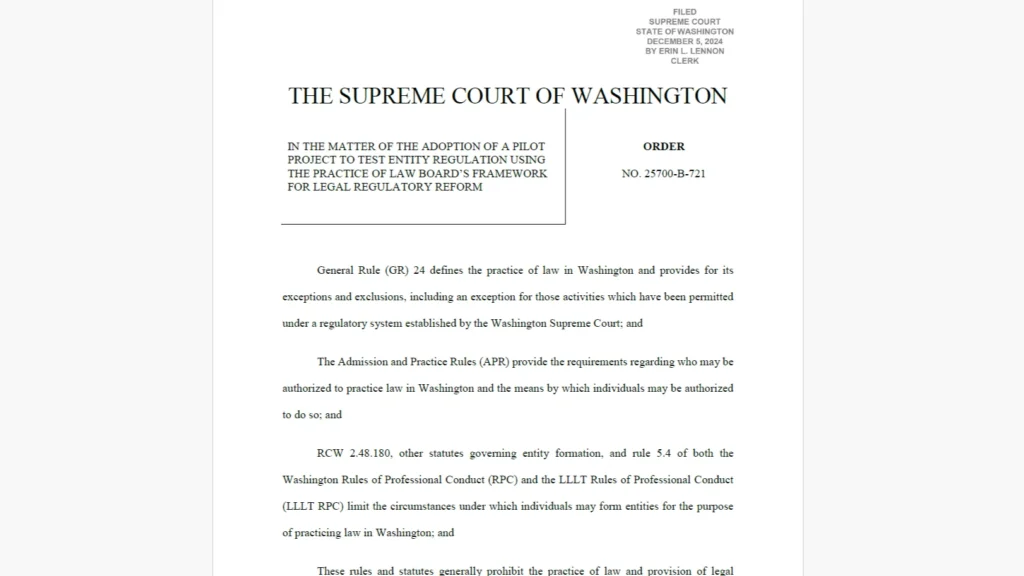
The Washington Supreme Court has approved a pilot program to permit entities not owned by lawyers, including companies and nonprofit organizations, to provide legal services under specific monitoring conditions. This initiative follows similar regulatory reform efforts undertaken in Utah and Arizona.
Overview of the Court’s Order
The court’s order (Order 25700-B-721), dated December 5, formally sanctions a framework proposed by the Supreme Court’s Practice of Law Board and the Washington State Bar Association (WSBA). The order directs these two bodies to collaborate on the program’s establishment and implementation. The pilot is scheduled to run for a period of ten years starting from the date the first entity is approved for participation.
The court explicitly stated its motivation for the initiative. Chief Justice Steven González signed the order, which read in part: “This Court has determined that a pilot project to test entity regulation under the proposed Framework will assist the Board, the WSBA, and this Court in determining whether entity regulation will increase access to justice by enhancing access to affordable and reliable legal and law-related services consistent with protection of the public, and whether entity regulation will create risks of consumer harm, regulatory challenges, or other risks that would serve as barriers to implementing reform.”
Regulatory Exception and Oversight
The pilot program introduces an exception to Rule 5.4 of the Washington Rules of Professional Conduct, a rule that traditionally limits the practice of law and delivery of legal services to entities owned by licensed attorneys. The approved nonlawyer-owned entities will be authorized to practice law, but only under strict conditions. These conditions mandate active monitoring and oversight throughout the entity’s participation.
Each participating entity must designate a compliance officer. This officer’s responsibilities include guaranteeing the entity’s adherence to the court’s authorizing order and all applicable ethical rules. The compliance officer will also be tasked with regularly reporting operational data to the WSBA.
Data Collection and Program Focus
A primary focus of the pilot is the systematic collection of data. The court’s order underscores this point, stating: “The purpose and focus of this pilot project are to collect data and information to inform reform efforts related to the regulation of the practice of law, and more specifically, to rules and regulations governing entities engaging in activities whether or not they constitute the practice of law.”
The WSBA is directed by the order to develop a formal complaint procedure allowing the public to report any alleged violations of the rules by participating entities or their personnel. Following an investigation, the WSBA will be authorized to recommend an entity’s removal from the pilot program if deemed appropriate.
Application Requirements and Innovation
Entities applying to participate in the program must submit a proposal that includes a “specific hypothesis” regarding:
- Reforming one or more regulatory rules governing entities practicing law and, if applicable, other related rules.
- That reform’s anticipated impact on the accessibility of legal services in Washington.
The proposal must also specify a study designed to test the applicant’s proposed regulatory reform.
Terra Nevitt, WSBA Executive Director, commented on the significance of the pilot in a statement issued by the bar: “A lot has changed in 100 years, but not when it comes to legal regulation. Now we are at a regulatory crossroads. The technology revolution is here, as well as exciting new business models. This pilot will help us understand whether and how we can harness that innovation — with public protection as our top priority — to meaningfully expand legal services for Washingtonians.”
Readers interested in updates regarding the logistics, timing, and application process for the pilot can find information posted at www.wsba.org/pilot-project. This news represents a significant development for Human&Legal as the legal industry adapts to evolving needs for greater access to justice.